


The Coppergate Clinic, York
8 Coppergate, York YO1 9NR
An independent clinic in the centre of York, with secure parking a short walk away.
Directions
Total facial rejuvenation, centred on deep plane face and neck lift surgery.
Mr Christopher West is a consultant plastic surgeon based in Yorkshire. Patients travel to see him from across the UK and overseas.











“For me, one of the most important parts of a consultation is deciding what not to operate on.”
Mr West is a consultant plastic and reconstructive surgeon. His private practice is built around the face and neck, with the deep plane face and neck lift at its centre.
He qualified in medicine at the University of Sheffield in 2004. Surgical training took him from Yorkshire to Edinburgh and Dundee. His PhD at the University of Edinburgh studied the stem cells found in human fat.
In the NHS he is a consultant at Leeds Teaching Hospitals, where his work covers sarcoma surgery, microsurgery and complex reconstruction. He appeared in the BBC Two series Saving Lives in Leeds.
In 2018 he completed an advanced training fellowship in cosmetic surgery. He continues to train alongside facelift surgeons in the UK, Europe and the USA.
A deep plane facelift lifts the face from beneath the SMAS, the muscle layer that carries facial shape. Mr West releases the retaining ligaments directly, so the whole layer moves together as one piece. Below is a cross-section through the cheek.
The outer layer. In a deep plane facelift the skin moves with the tissue beneath it instead of being pulled tight on its own.
The fat that gives the cheek its fullness. Where it has thinned, Mr West can restore volume with the patient's own fat.
The muscle layer that carries the shape of the face and continues into the neck as the platysma. This is the layer a deep plane facelift lifts.
Fibrous ties that hold the SMAS down. Mr West releases them by direct dissection so the face can move as one piece.
The deepest layer, where the branches of the facial nerve run. The deep plane sits directly above it.
The shape of the neck is not set by skin and superficial fat alone. Fullness under the jaw often comes from deeper structures: deep fat, the digastric muscles and the submandibular glands. Mr West assesses each layer and treats only the ones shaping the neck. Below is a section beneath the jaw, seen from the front.
The outer layer. It is redraped over the deeper structures once they have been treated.
Mr West rarely removes this layer, because it keeps the neck looking even and natural.
A thin sheet of muscle from the chest to the lower face. With age it can loosen into vertical bands. It can be repositioned or tightened.
Fat beneath the platysma that skin tightening cannot reach. In selected patients it can be reduced.
Prominent digastric muscles can add fullness in the centre of the neck. In selected patients they can be carefully modified.
Salivary glands beneath the jaw. When prominent, part of each gland can be reduced through the same small incision under the chin. The rest keeps producing saliva.
“The aim is not the tightest neck. It is the right neck for you.”
300+Submandibular gland reductions performed by Mr West.
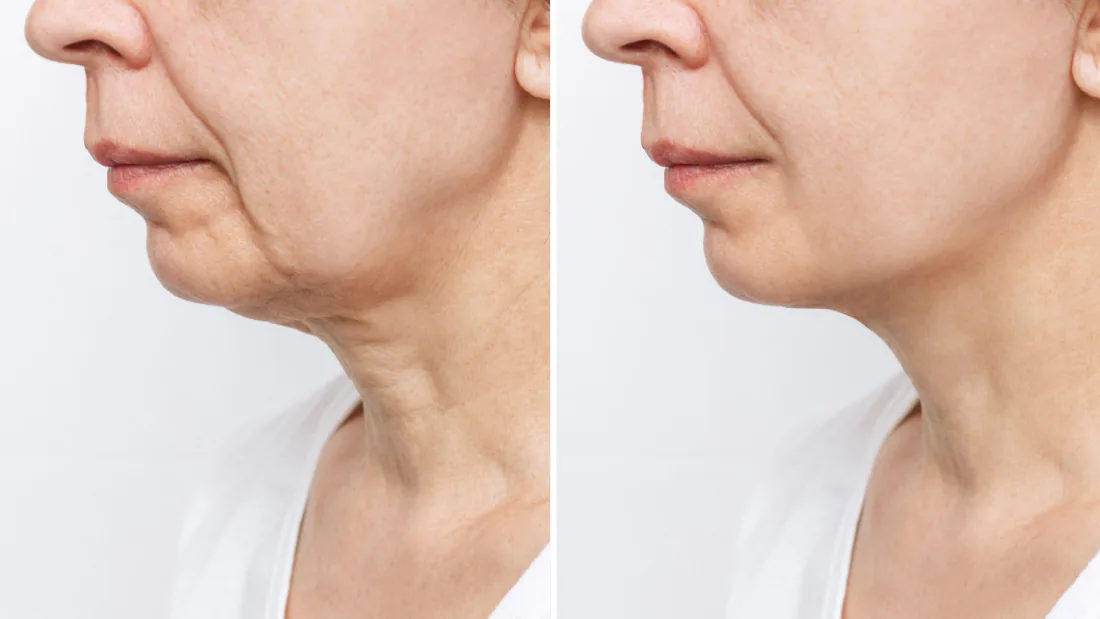
Every pair is one of Mr West's own patients and is published with their consent. Results vary from person to person.

Each pair shows one of Mr West's own patients before surgery and after healing. Swelling settles over several weeks and the final result is usually visible between three and six months.
A short introduction to how Mr West approaches facial surgery, from the first consultation through to recovery.
“Two patients may both ask for a deep plane facelift but have very different anatomy.”
Facial surgery leads the practice, with the deep plane face and neck lift at its centre. It is often combined with eyelid surgery, a lip lift or facial fat grafting.

 Illustration
Reviews from Mr West's Google profile, published as written.
Most of Mr West's patients come from outside Yorkshire, from across the UK and overseas. The team helps with timings, travel and somewhere comfortable to recover.
8 Coppergate, York YO1 9NR
An independent clinic in the centre of York, with secure parking a short walk away.
Directions
Roundhay, Leeds LS8 1NT
A CQC registered private hospital in Roundhay, with parking on site for patients.
DirectionsThe questions patients ask most often. Anything specific to one patient is covered at the consultation.
A deep plane facelift releases the retaining ligaments and lifts the SMAS, the muscle layer under the skin, together with the skin as one unit. A traditional SMAS facelift tightens the skin and the SMAS separately without releasing the ligaments.
A facelift does not stop ageing. The face carries on ageing from its new starting point. Published data put the average time before a second facelift at around 11 years. It is longer for people who have their first facelift younger.
Most patients have a facelift between their late 40s and early 60s. Suitability depends more on anatomy and skin quality than on age.
The incisions sit around the ears and within the hairline. Scars usually settle and fade over the following months.
Expect 2 to 3 weeks of visible swelling and bruising. Most patients return to work and social plans within 10 to 14 days. The result keeps improving over several months.
No. Some patients get an excellent neck contour without the glands being touched. Mr West reduces them only when they are adding real fullness under the jaw, which is the case in 80% or more of the neck lifts he performs.
Yes. Common combinations include a neck lift, upper or lower eyelid surgery, a lip lift and facial fat grafting.
Mr West operates at the Coppergate Clinic in York and Spire Leeds Hospital. The right location is agreed at the consultation.
Yes. Mr West aims to restore a patient's own features, not to change them. Every operation is planned around the patient's own anatomy.
A consultation with Mr West covers the anatomy, what surgery can realistically achieve and the risks involved. A fixed written quote follows afterwards.
Surgery is only planned after this assessment, with time to reflect before any decision. Virtual consultations are available for patients travelling from further afield.

Mr West's advice articles, sent once a month by email.
This site is protected by reCAPTCHA and the Google Privacy Policy and Terms of Service apply.
